The small saw blade is slightly pulled out from the bottom, by means of a pneumatic actuator, ino order to cut the element. The work area of the saw blade is secured by housing and actuators that hold down the fabric to be cut. The work area where the fabric is cut has been limited to 5cm x 25cm (H x W). The saw is equipped with roller feeders (or table tops with a special antistatic liner) 3m and 2.7m long. The shorter feeder features a programmable bumper, moving from the saw at a distance of 2.5m with a servo motor. The saw blade features a pneumatic clamp. The saw is equipped with Zebra label printer, keypad output and Delta touch panel. The program is designed to make the use of the saw as simple as possible. Production order data is transferred from the computer (technical requirements: Windows OS and MS Excel) to the saw driver and then to the panel. An exit from automatic and manual saw operation is also provided.
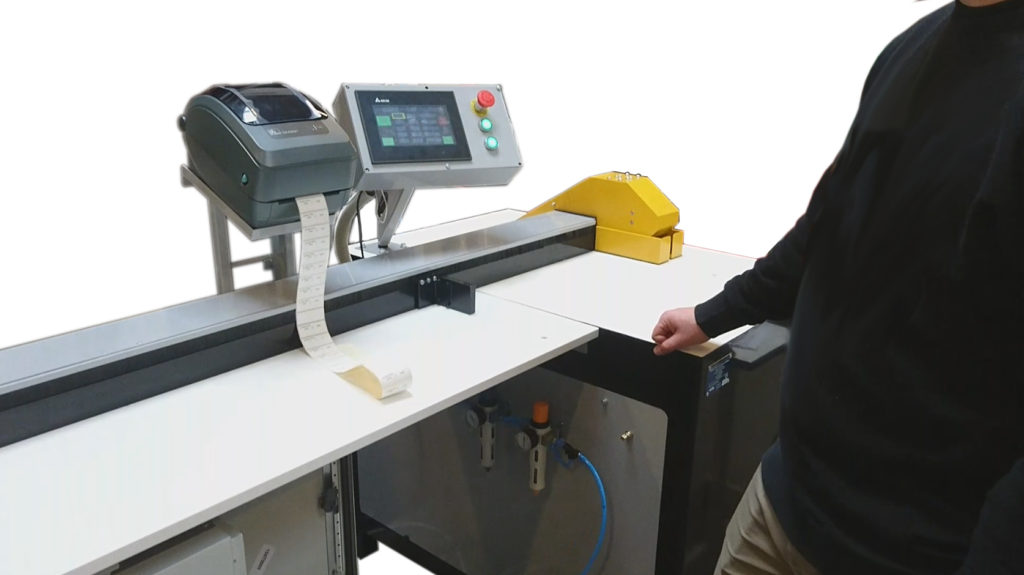
Apart from the saws on our offer, we can also offer a cutting station with an off-the-shelf saw. This workstation features two 2m and 2.5m long feeding tables. Under the table tops shelves have been provided for storing finished products or components needed for production. On longer table tops, a sliding bumper is mounted, which is programmable from the touch panel level. The saw itself is levelled so that the cut fabric is at the table top level and adjusted to be on the perforated plate under which a chute for chips and cuttings is provided. An arm with pneumatic connection and a gun to clean the workplace is mounted above the saw. The customer may choose whether the work tables are to be supplied with rollers or table tops covered with antistatic lining. Additionally, it is possible to opt out from the bumper driven by a servo motor and the touch panel, and in stead use a manual adjustment of the gauge. With the manual option, the distance can be read out with a measuring tape on the table or by means of a digital display and magnetic strip.
]]>A gauge is a mobile device that can be installed on many different workstations. It is used forme asuring the distance of the cut material. The gauge is available in 3 versions: manually moved, locked, with distance reading from the measuring tape; manually moved and locked, distance displayed on a digital display (measurement is carried out by means of magnetic strip with sensor); bumper with servo-motor drive, programmable from the touch panel. Depending on the needs of each manufacturer, it is possible to precisely measure the fabric to be cut.
]]>Instead of measuring tape with manual locking gauge, we propose the use of magnetic measuring system with digital display. With this solution it is possible to achieve an accuracy of 0.1 mm.
Another option is automated guillotine with programmable gauge, with the use of a servo motor, gearbox, touch panel. The operator inputs the width of the pleated blind to the panel – the bumper that serves as a base, goes to the distance, the operator positions the fabric, pushes “start” on the panel – fabric is holded and then cutted.
If your company uses scanners and label printers at different stages of production, they can also be used with a programmable bumper guillotine. In such a situation, the program is adapted to the existing program in the company.


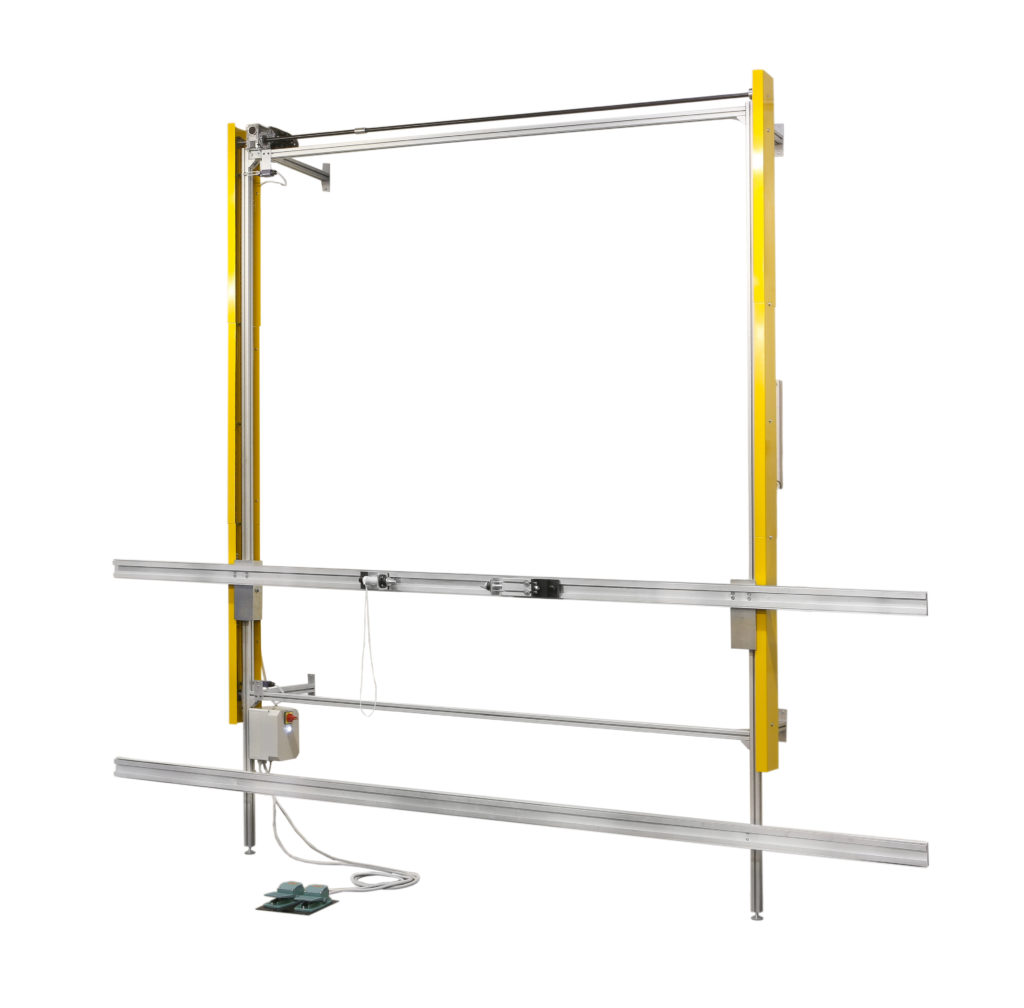
This version of the TR-A tester is very similar to a normal TR-A lift. The difference is that one more mounting roll is provided underneath the moving roll with clamps, which is stationary. The holders for pleated blinds are also different – we make them for specific systems sent by the customer. In addition, in order to make full use of the lift’s possibilities for checking the pleated blinds, the lift should be equipped with a drive and a control cabinet steered from the touch panel – an employee who controls the finished product can be sure that the height of the pleated blind is in accordance with the order. Of course, setting the width between the holders can also be automated. Another option is a tester for checking irregular shaped pleated blinds.


Cutting table for profiles PPS-P
Components of the table:
– Worktop at the input with a length of 2m,
– Shelf below the saw,
– Worktop at the output with a length of 2.5m with a gauge and bumper,
– Bottom shelves for storing production elements
Table with a press for punching holes in rails PPS-L
Components of the table:
– Worktop at the input with a length of 3.0m,
– Shelf under the press and the die,
– Worktop at the output with a length of 2.5m with a gauge and bumper,
– Bottom shelves for storing production elements
Table for cutting pleated material and for drilling holes in pleated fabric PPS-T
Components of the table:
– Worktop at the input with a length of 2.0m,
– Shelf under the saw to cut the fabric,
– Worktop central intermediate with a length of 2.5 m,
– Shelf below the drill,
– Worktop at the output with a length of 2.0m,
– Bottom shelves for storing production elements
Table for assembly pleated blinds – PPS-M
Components of the table:
– Worktop with a length of 3.0 m for the assembly of “spider” material
– Top shelf for elements,
– Bottom shelves for storing production elements


